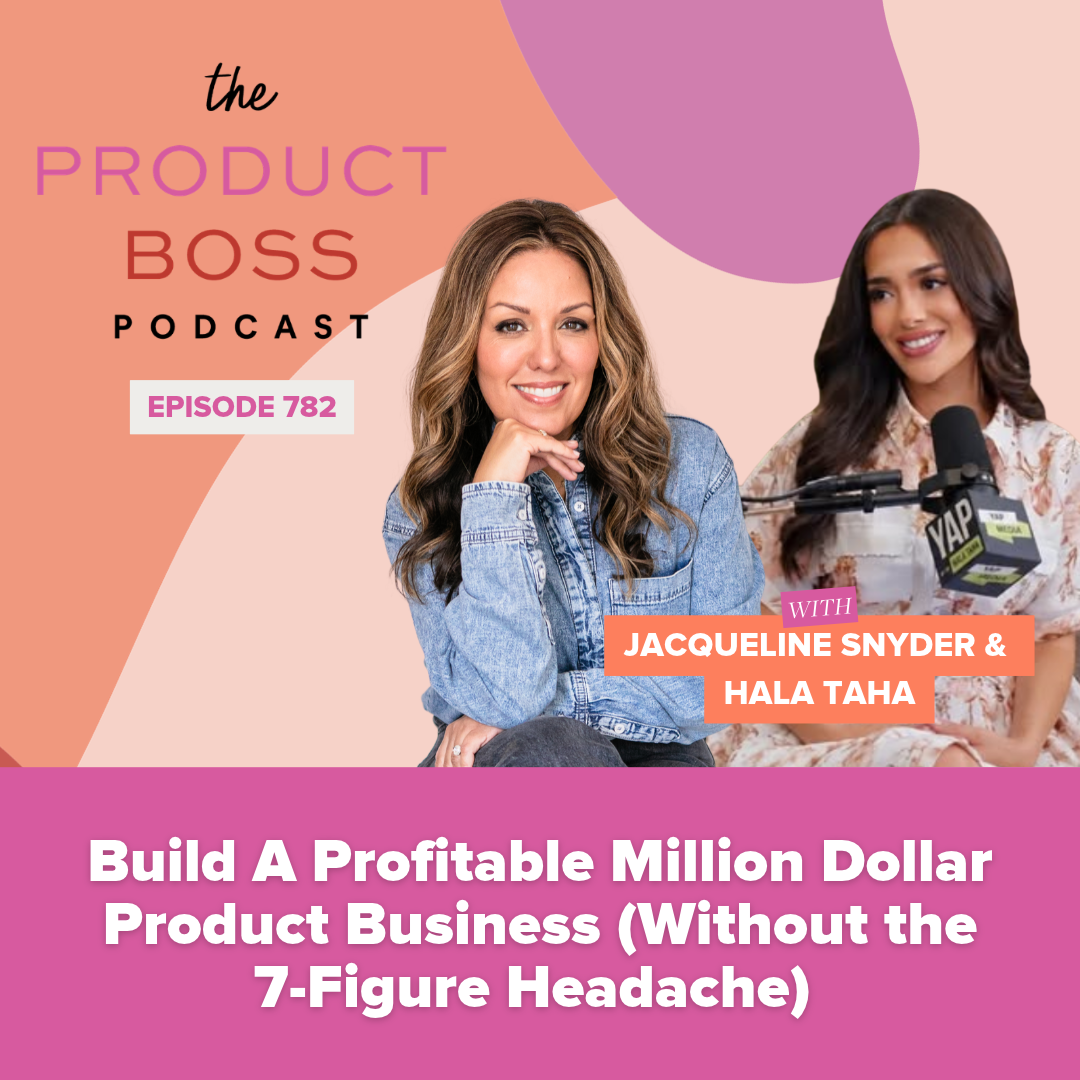
Welcome back, Product Bosses! Welcome back, Product Bosses! It has never been easier to launch a business, with AI, Shopify, and everything on the internet, and yet it's harder than ever to run a profitable one. This episode is a special one, because you get to hear me on the other side of the mic as a guest on Young and Profiting with Hala Taha. We cover why product businesses struggle with profit in 2026, how to double down on your bestseller, how to get in front of customers without paying for every click, and how to build a company that runs without you. If you've ever wondered how to raise your prices without upsetting your customers or what to do to drive sales for Q4, this one is for you.
HOW TO BUILD A MORE PROFITABLE PRODUCT BUSINESS IN 2026: BESTSELLERS, PRICING, AND OTHER PEOPLE'S AUDIENCES
The reason profit is so hard right now is that product costs money to start and money to build, and costs keep rising through higher wages, import fees, and duties. Customers want things cheaper, but the cost of goods is everything. Then there's cash flow. When I worked in fashion, it could take an entire year to design, produce, and ship a product, and the big stores paid 90 days after that, so I teach clients that debt isn't the villain, it's leveraging cash. The fix I start with every time is your bestseller, also known as your hero product or core collection. People think they need more to sell more, but when they look at their numbers, 80% of their revenue comes from 20% of their products. Juicy Couture hit on the tracksuit and made every variation of it, because that's where the money was. You can't reinvent the wheel, but you can redesign it. The key is to check whether your bestseller is actually profitable behind the scenes. One client's top seller had constant breakage and returns, so we had to "kill the darling" and shift to her second bestseller, and she ended up selling out every week. Entrepreneurs get bored before the customer does, so watch your numbers and your culture to know when to shift.
The second piece is getting discovered without paying for every click, which I call the OPA method, other people's audiences. When I launched my wearable wrist wallet, Cuffs Couture, I built a website and got crickets, because nobody is typing "wearable wrist wallets" into Google. I pivoted to wholesale and in-person markets in LA, and getting on shelves in front of other people's audiences led to Carrie Underwood discovering my products and Kim Kardashian wearing them, without me paying for their attention. That's still relevant, because five out of every six dollars are still spent in person, Gen Z is bringing back the mall, and people want to discover things in the age of AI, the way they do at Home Goods and TJ Maxx. I call my marketing framework POP: paid, organic, and partnership. Ads are worth it only if your website converts, and my test is the "grandma test," which asks whether she'd know what you sell and where to click within three seconds. And there's a big difference between posting and promoting. Decide what you're promoting each week, like the fall collection and then your bestseller, send at least one email a week, and show behind-the-scenes moments, because people love to see how something is made. I'll even put a stake in the sand and say you don't need social media at all, but if you do it, get good at it.
The third piece is pricing, profit, and building a business that runs without you. It's very hard to race to the bottom, and you're not competing with Target. Temu has knocked off several of my clients, and the answer is to build a brand people connect with and attract a better customer, which is often done by raising your prices. My simple pricing formula is cost of goods times two for wholesale, then times two again for retail, including your labor. My cuffs cost $5 to make, sold for $11 wholesale, and the boutiques sold them for $25. Never undercut your retailers, since they're your partners, and watch for profit leaks like marketplace fees and raw goods you haven't renegotiated. When clients raise their prices, they're terrified, and then nobody blinks. Use sales to move product and turn it back into cash, not to drive sales, and set your free shipping threshold above your average order value, like $75 when your average is $50. When we played Fix My Product Business, I walked through scenarios like a candle company making $500,000 a year and taking home little (fix the margin first), a $100,000 retail order that would drain a founder's savings (don't take it if it's everything you have, and look at lines of credit, SBA loans, and factors), and a skincare brand where only 15% of customers come back (find out why before doubling your ads). We closed on the three phases of leadership: the doer, who is still in everything, the owner, who owns outcomes and hires experts, and the boss, who lets the company thrive when she takes two weeks off. After losing my mom, I set a goal of 30% more profit with 30% less personal involvement, and we hit it in a 10 week sprint, because I focused on what works and repeated it.
The key takeaways from this conversation are:
Know your numbers, and double down on your bestseller. Look at your costs versus what you sell for, find where money is leaking, and put your effort behind the 20% of products driving 80% of your revenue.
Get in front of other people's audiences. Wholesale, in-person events, marketplaces, podcasts, and partnerships put you in front of customers without paying for every click, and promoting a clear message each week beats just posting.
Price for profit and build a business that runs without you. Use the cost times two, times two formula, raise your prices, never undercut your retailers, and move from doer to owner to boss.
Product Boss, remember: math, not drama. Look at your numbers, find the money leaks, and let the data tell you what to do next. A big thank you to Hala Taha for having me on Young and Profiting, so be sure to follow her on Instagram @yapwithhala and listen to the full episode there. And if you want to work on your profit with me, join one of my free workshops HERE!
In This Episode, You’ll Learn:
00:00 Why launching a business is easier but becoming profitable is harder.
02:15 The 5 systems behind building a successful product business.
05:00 The strategy for finding customers without relying entirely on paid ads.
06:15 Why in-person shopping and product discovery are making a comeback.
10:00 When to update your bestseller without abandoning what's already working.
12:00 Building a product lineup around what customers actually want.
16:45 When should you price products affordably versus positioning them as premium?
21:00 A pricing formula for calculating wholesale and retail prices.
24:30 Common profit leaks in product businesses and ways to protect your margins.
27:30 When is your business ready to invest in paid ads?
28:45 How to turn social media posts into content that actually promotes your products.
31:30 Behind-the-scenes content ideas that can make even ordinary products interesting.
37:30 Creating product content that builds trust and inspires customers to buy.
43:15 How The Product Boss Collective helps entrepreneurs get the right support and guidance.
48:30 How to diagnose what's keeping a product business from becoming profitable.
54:00 How to approach a major wholesale opportunity without creating a cash-flow crisis.
58:00 Why you should fix customer retention before spending more on customer acquisition.
01:02:15 What drives customers to buy from you again?
01:06:15 Increasing average order value with a smarter free-shipping threshold.
01:09:15 Stepping into the Owner and Boss roles to create a more self-sufficient business.
01:13:15 Building a business that generates 30% more profit with 30% less personal involvement.
Resources + Links
Ready to lead, run, and grow your product business beyond a million dollars, without being the bottleneck? Join me this week for a FREE workshop HERE!
Ready to stop guessing and follow a proven system? Book your strategy call HERE!
Get business tips sent right to your inbox - join the newsletter!
Follow
Jacqueline on IG: @theproductboss
Hala Taha on IG: @yapwithhala
